 Save
Save My grandmother kept a particular tube pan in the back of her cabinet, reserved solely for angel food cakes that appeared at every family gathering without fail. I watched her whip egg whites into clouds so voluminous they seemed to defy physics, and the result was always this impossibly light cake that tasted like sweetened air. The first time I attempted it myself, I was terrified I'd ruin those twelve eggs, but something about the gentle folding and the trust required in the process changed how I thought about baking. Now, whenever I make this cake, I'm reminded that some of the most elegant dishes are built on simplicity and patience.
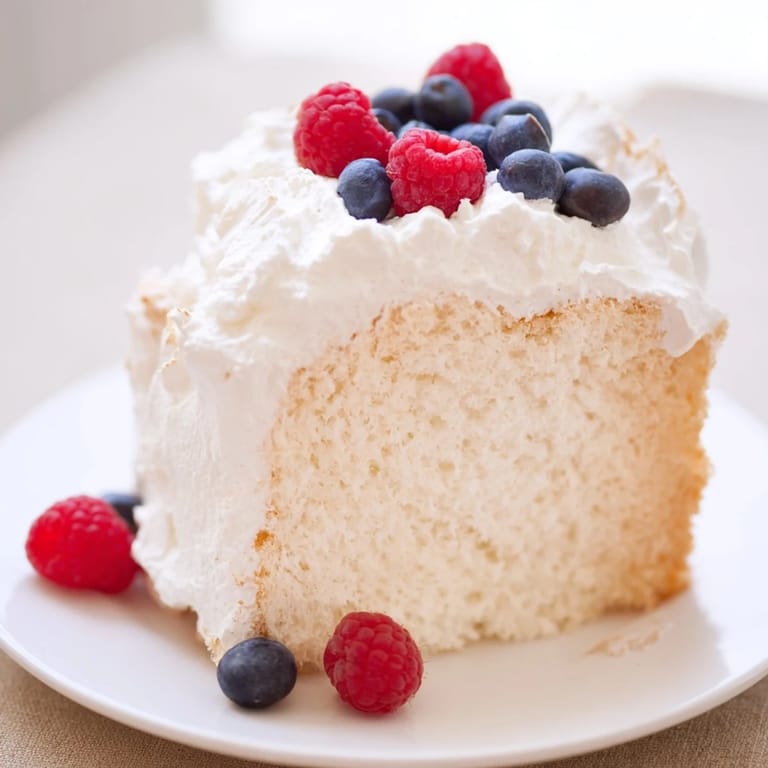
I remember bringing this cake to a potluck on a humid summer afternoon, worried the humidity might affect the delicate structure. When I sliced into it at the table, the knife practically glided through, and someone actually gasped at how tall and perfect it looked inside. That moment taught me that angel food cake isn't just dessert—it's a small act of showing up for people with something that took real care to make.
Ingredients
- Cake flour (1 cup, sifted): This is non-negotiable for the tender crumb you're after; all-purpose flour will make the cake denser and tougher than intended.
- Granulated sugar (1½ cups, divided): The split between the dry mixture and the egg whites matters—it helps stabilize the meringue while sweetening the whole cake evenly.
- Fine salt (¼ teaspoon): Just a whisper of salt to enhance the vanilla and balance the sweetness so nothing tastes one-dimensional.
- Large egg whites (12, room temperature): Room temperature eggs whip faster and to greater volume; cold eggs will fight you the entire way.
- Cream of tartar (1½ teaspoons): This stabilizes the egg whites and gives them that glossy, stiff peak quality that holds the structure together.
- Pure vanilla extract (1 teaspoon) and almond extract (½ teaspoon, optional): The vanilla is the backbone of flavor; the almond is a subtle flourish that makes people ask what the secret ingredient is.
Tired of Takeout? 🥡
Get 10 meals you can make faster than delivery arrives. Seriously.
One email. No spam. Unsubscribe anytime.
Instructions
- Set yourself up for success:
- Preheat your oven to 350°F and make absolutely certain your tube pan is pristine and completely dry—any residue or moisture is the enemy here. This pan must remain ungreased because the batter needs that friction against the sides to climb and rise.
- Build your dry base:
- Sift your cake flour, ¾ cup sugar, and salt together, then sift the whole thing two more times. This triple sifting aerates the flour and distributes everything evenly, which sounds fussy but genuinely makes a difference in the final texture.
- Create the meringue:
- Beat your room-temperature egg whites until they're foamy, then add the cream of tartar and keep beating until soft peaks form—this takes about three to four minutes depending on your mixer. Gradually add the remaining ¾ cup sugar a little at a time while the mixer runs, and don't rush this part.
- Reach stiff peaks:
- Continue beating until the peaks stand straight up and the meringue looks glossy and dense, like marshmallow frosting. Add your vanilla and almond extracts and fold them in gently with just a few turns of the whisk.
- Fold in the flour carefully:
- This is where patience becomes your secret weapon—sift the flour mixture over the egg whites in three separate additions, folding gently with a rubber spatula after each addition. Stop folding the moment everything is just combined; overmixing deflates all that airy work you just did.
- Transfer and smooth:
- Spoon the batter into your ungreased tube pan and smooth the top gently with a spatula, then run a thin knife through the batter in a circular pattern to break up any large air pockets that might create tunnels.
- Bake until golden:
- Slide the pan into the oven for 35 to 40 minutes until the top is golden and the cake springs back when you touch it lightly. The cake should smell vanilla-sweet and a little toasted, but not dark.
- The crucial inversion:
- This is the strangest and most important step—immediately flip the pan upside down onto a bottle neck or wire rack and let it hang there cooling completely for one to two hours. This prevents the cake from collapsing under its own weight as it cools.
- Release and serve:
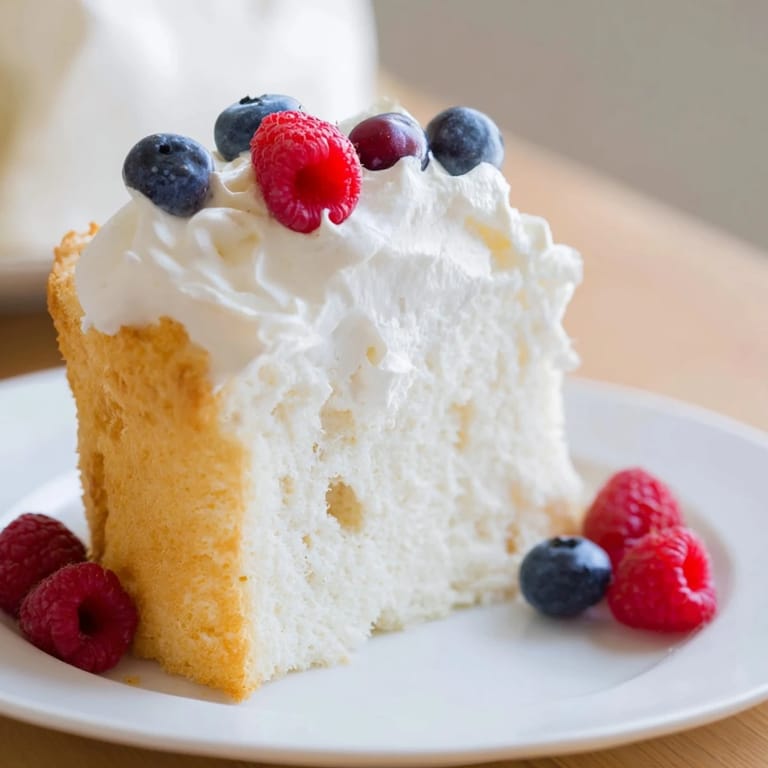
- Once completely cool, run a thin knife around the edges and the center tube to loosen the cake, then turn it right-side up onto a plate. Serve it plain, with fresh berries, whipped cream, or however your heart desires.
 Save
Save I learned the hard way that angel food cake has a particular magic—it's proof that restraint and technique can create something more memorable than a rich, heavy cake ever could. There's something almost spiritual about that first slice, how the knife barely needs pressure and the cake seems to surrender gracefully.
Why This Cake Became My Go-To
For years I avoided angel food cake because I assumed it would be dry or bland, but I was completely wrong. The first time I actually made one properly, I realized it's the opposite—it's moist from the egg whites and so delicate that fruit and cream feel like luxurious additions rather than cover-ups. Now it's the cake I reach for when I want to impress people without spending all day in the kitchen or dirtying a dozen pans.
Room Temperature Matters More Than You Think
I used to pull my eggs straight from the fridge until a baker friend explained that cold egg whites take nearly twice as long to whip and don't reach the same volume as room-temperature ones. Set them out on the counter for thirty minutes before you start, and you'll notice the difference immediately—the mixer whirs, the whites transform faster, and everything feels less like you're fighting the ingredients. It's one of those small adjustments that feels subtle but changes everything.
Variations and Personal Touches
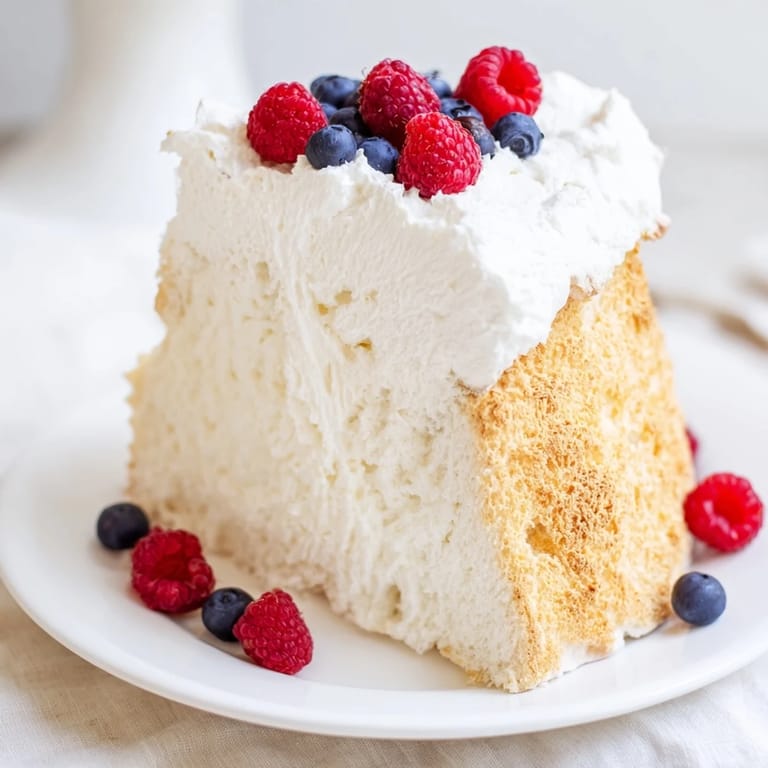
The beauty of angel food cake is its flexibility within simplicity—I've added lemon zest for brightness, a hint of cinnamon for warmth, and once even a whisper of rose extract that nobody could quite name but everyone loved. You can top it however you like: fresh berries, a drizzle of fruit coulis, whipped cream, or even a light dusting of powdered sugar. The cake itself is the canvas, and you're the one deciding what story it tells at your table.
- Fresh raspberries or strawberries tumbled over a slice with whipped cream is the classic for a reason.
- Try a simple berry compote or coulis made by cooking berries down with a touch of honey and lemon.
- For something different, serve slices with a light citrus curd or even a small scoop of vanilla ice cream.
 Save
Save Angel food cake taught me that sometimes the simplest ingredients, treated with respect and care, create something that sticks with people far longer than any complicated dessert ever could. Every time I make it, I think of my grandmother and how she knew something I'm still learning—that elegance and lightness are often the same thing.
Recipe FAQ
- → What is the key to achieving the cake's light texture?
Whipping egg whites to stiff peaks and carefully folding in sifted cake flour maintains the airy structure essential for the cake's lightness.
- → Why is the pan left ungreased?
An ungreased tube pan allows the batter to cling to the sides, which helps the cake rise properly and maintain its height.
- → How should the cake be cooled after baking?
The cake should be inverted onto a bottle or rack while cooling to prevent collapse and preserve its fluffy texture.
- → Can any extracts be added to enhance flavor?
Vanilla extract is added for subtle sweetness, and almond extract may be included optionally for additional depth.
- → What are suggested accompaniments for serving?
Fresh berries, whipped cream, or a light fruit compote complement the airy texture and mild sweetness beautifully.